University of Manchester: Digital Health Equity Seminar
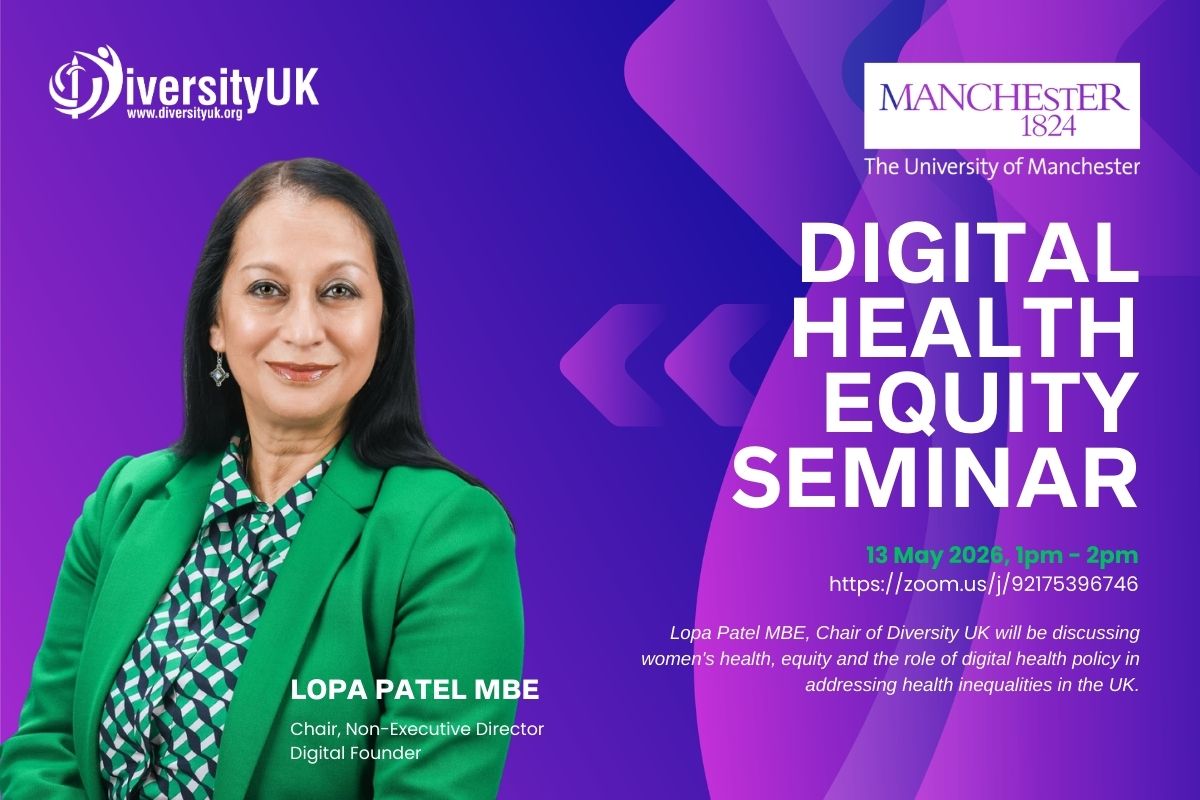
The University of Manchester's Christabel Pankhurst Institute, in collaboration with Digital Futures, is hosting a seminar series with speakers from different disciplines who have done exemplary work on understanding, identifying, or addressing digital health inequities. Lopa Patel MBE, Chair of Diversity UK, will be giving the next seminar in the University of Manchester Digital Health Equity Seminar Series is on Wed 13th-May, 1-2pm BST via Zoom, when she will be talking about women's health, equity and the role of digital health policy in addressing health inequalities in the UK.
University of Manchester
Digital Health Equity Seminar (online)
13 May 2026, 1pm - 2pm
https://zoom.us/j/92175396746
Health inequalities remain one of the most significant challenges
Health inequalities remain one of the most significant challenges facing modern healthcare systems. They are visible across gender, ethnicity, geography and socioeconomic status, and they shape both health outcomes and opportunities for innovation. While the UK's health system was founded on the principle of fairness with the creation of the National Health Service in 1948, disparities in access to care, treatment and investment continue to persist.
Women's health illustrates this challenge clearly. Women spend approximately a quarter more of their lives in poor health than men, yet female founders receive less than 2 per cent of global venture capital funding. This imbalance affects the development of products, services and research that address women's health needs.
According to the 2024 report Closing the Women's Health Gap: A One Trillion Dollar Opportunity to Improve Lives and Economies by the McKinsey Health Institute, narrowing the women's health gap could improve the lives of 3.9 billion women and contribute one trillion dollars annually to the global economy by 2040. Health equity is therefore not only a matter of justice but also an economic imperative.
Digital health technologies offer significant opportunities to address these challenges. However, they also raise new questions about fairness, representation and trust. Discussions hosted by Diversity UK with the Frugal AI Hub and Cambridge Judge Business School have highlighted several recurring issues. These include regulatory barriers that slow innovation, the risks posed by incomplete or biased datasets, limited engagement between clinicians and technology developers, and the possibility that poorly designed artificial intelligence systems could amplify existing inequalities.
As the UK develops new strategies to modernise healthcare, including the Government's ten-year health plan Fit for the Future, there is a renewed focus on prevention, access and quality. Digital health policy will play an important role in shaping how technologies are developed, regulated and deployed across the health system. Ensuring that these tools serve diverse populations and address structural inequalities will be essential to building a fairer and more resilient healthcare system.
This seminar will reflect on how policy makers, innovators and researchers can work together to ensure that digital health contributes to greater equity rather than deeper divides.
Speaker's bio
Lopa Patel MBE is a digital founder and experienced Chair and Non-Executive Director specialising in governance, risk and responsible innovation. With a background spanning technology, data and public service, she brings strategic insight into the adoption of artificial intelligence across complex systems, including healthcare.
She currently serves as Chair of Diversity UK and holds non-executive roles with The National Archives and the NHS South West Peninsula Cluster Board, where oversight of performance, risk and public trust are central to her work. She is an adviser to the Enterprising Women programme at Murray Edwards College, University of Cambridge, and a judge for the King's Awards for Enterprise in the Innovation category.
Recognised for her leadership in technology and innovation, she was awarded an MBE for services to the creative industries and was named in Computer Weekly's UKTech50 2025 as one of the Top 5 Female Founders. She is a strong advocate for responsible, inclusive and impactful technology innovation, with a particular interest in the opportunities and risks associated with artificial intelligence.