Diversity UK Frugal AI debate on doing more with less in healthcare
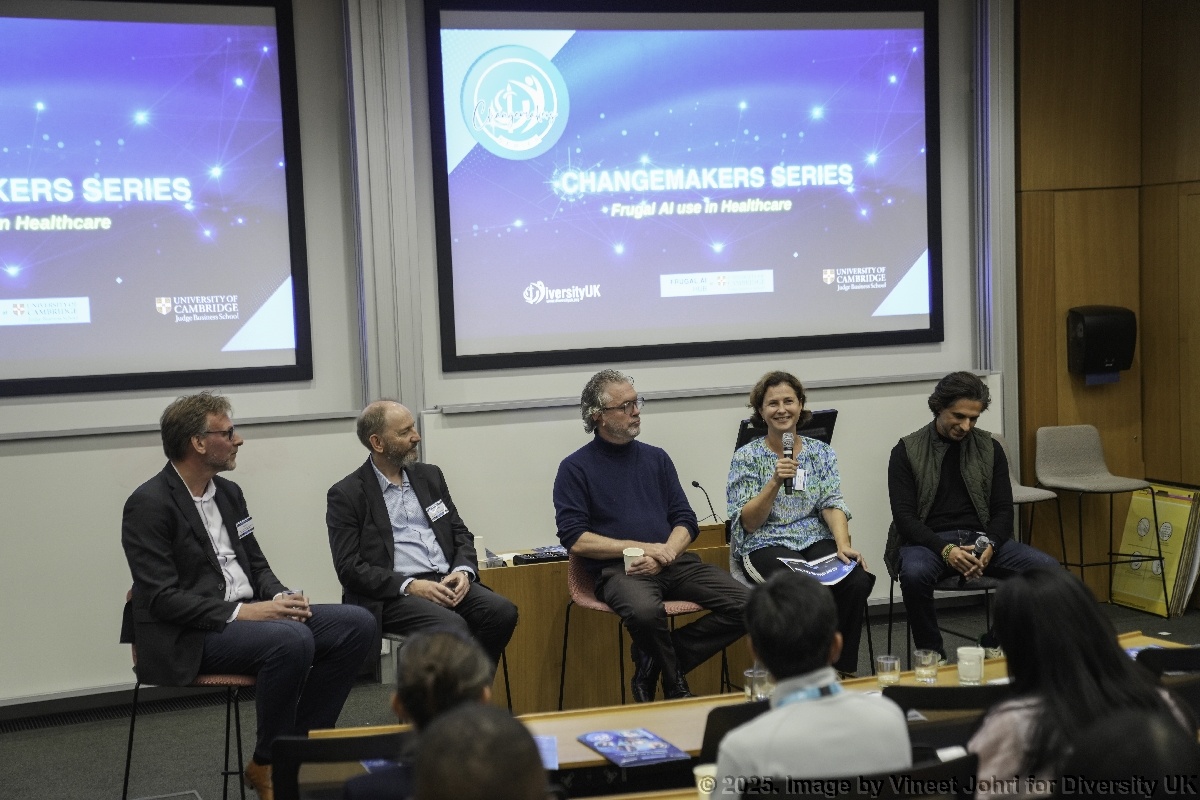
On 17 September 2025, Diversity UK launched the first in its Changemakers Series with a powerful and timely discussion on Frugal AI use in Healthcare. Held at the Cambridge Judge Business School as part of Cambridge Tech Week, the event brought together academics, clinicians, entrepreneurs, technologists and policymakers to grapple with one of the most pressing questions of our time: how can artificial intelligence be deployed in ways that are affordable, accessible, scalable and equitable?
This was not a debate about expensive, futuristic systems confined to laboratories or elite hospitals. Instead, it was a candid exploration of how AI might be made to work in real-world healthcare settings, from overstretched NHS wards to local GP surgeries, and even in people’s homes.
Setting the Scene: A Keynote on Shifts and Challenges
Professor Niels Peek of The Healthcare Improvement Studies (THIS) Institute, University of Cambridge, framed the discussion with an overview of the three Darzi shifts shaping modern healthcare:
- Moving care from hospitals into communities.
- Using digital technology to drive efficiency.
- Transitioning from treating illness to preventing it.
He emphasised that while AI offers potential breakthroughs in productivity, precision medicine and diagnostic support, the sector faces significant challenges:
- Market-user disconnect: Many AI tools do not align with actual patient and clinician needs.
- Evidence gap: Thousands of models exist, yet only a handful are implemented due to lack of validation.
- Mismatched timescales: Clinical trials take years while AI development moves in months.
- Skills shortages: Innovation requires expertise across healthcare, biology, compliance, software development and business management.
His conclusion was clear: the frontier is no longer about novelty but about productivity, equity and the ability to translate research into everyday care.
The Chair’s Call: Doing More with Less
Welcoming the audience, Lopa Patel MBE, Chair of Diversity UK, set the tone by challenging assumptions about AI in medicine. Too often, she argued, we imagine only “high-cost, cutting-edge systems” when in fact the true opportunity lies in Frugal AI – resource-efficient approaches that use limited data, lighter computational power and simpler models to deliver meaningful outcomes
She posed questions that would reverberate throughout the discussion:
- How do we ensure frugal AI reduces rather than reinforces health inequalities?
- What types of AI are most promising in low-resource settings?
- Should the emphasis be on cost savings or equity?
Insights from the Panel: Bridging Innovation and Implementation
The panel of distinguished speakers provided a rich tapestry of perspectives:
Kelvyn Hipperson, NHS Cornwall & Isles of Scilly ICB:
Highlighted the difficult choices commissioners face in selecting solutions with the greatest impact. He stressed the need for governance, strong pipelines and collaboration across academia, suppliers and regulators.
Dr Chris Laing, CEO of UCL Partners:
Noted that London’s diversity offers both challenges and opportunities. He argued that simple algorithms remain under-utilised, pointing out that “we can predict 80% of acute admissions” with data and simple algorithms we already have.
Caroline Cake, CEO of Neu Health:
Shared her journey from national-level data infrastructure to spinning out an Oxford innovation tackling Parkinson’s and dementia. She underscored the importance of better design processes and early involvement of clinicians and patients.
Mohammed ‘Sadeq’ Ali, Co-Founder of AccurKardia:
Offered a candid look at the arduous journey from lab to FDA approval, highlighting how high-quality datasets often clash with real-world population data. His work with ECG biomarkers exemplified how one innovation can have far-reaching applications.
Challenges Exposed
Several recurring themes emerged from the debate:
- Regulatory barriers: Compliance is often underestimated, with innovators under-prepared for lengthy approval pathways.
- Data dilemmas: Poor quality, biased or incomplete datasets undermine AI models. Synthetic data can help but cannot fully replace real-world diversity.
- Clinician engagement: Doctors may not be aware of AI’s possibilities, while technologists may overlook the realities of clinical practice.
- Equity gaps: Without careful design, AI risks deepening inequalities by failing to reflect diverse patient populations.
Futures Imagined
In a thought-provoking close, panellists were asked what frugal AI breakthrough they hoped to see within five years. Their answers painted a picture of possibility:
- Personalised medicine from cradle to grave (Sadeq Ali).
- The first person cured of dementia through targeted AI therapies (Caroline Cake).
- Digital care pathways that reduce health inequalities (Chris Laing).
- Ambient voice transcription freeing clinicians for more meaningful patient conversations (Kelvyn Hipperson).
- A more effective innovation ecosystem within the NHS (Niels Peek).
Why It Matters
The discussion reinforced that frugality in AI is not about cutting corners but about maximising impact. It is about listening to patients and clinicians, prioritising equity, and ensuring solutions are affordable and adaptable. In a health system under immense pressure, frugal AI may well prove to be not just an innovation, but a necessity.
Tech showcase highlights
The discussion was followed by a lively Tech Showcase, moderated by Elizabeth Osta, Co-Lead of the Frugal AI Hub and Visiting Fellow at Cambridge Judge Business School.
Three innovators presented solutions that embodied the spirit of frugal innovation:
Viktorija Smith, Co-Founder of Respoken, showcased a digital health platform designed to help people with aphasia and other communication difficulties access personalised support.
Linia Zambezi, Founder of Afromics, described how her genomics start-up is building a large-scale African biobank to enable inclusive precision medicine.
Mohammed ‘Sadeq’ Ali, Co-Founder of AccurKardia, demonstrated how the company uses AI to interpret both visible and hidden signals in ECGs, creating a broad biomarker to predict cardiovascular disease and other conditions, ultimately aiming to save lives.
For Alice Huang, Trustee of Diversity UK, who gave the closing remarks, the vision was clear: “Every resource matters, every life matters. Equitable models are fundamental to delivering a step change in healthcare.”
Looking Ahead
The Changemakers Series will continue with future events exploring themes such as The Entrepreneurial Mindset. Just as with healthcare, the aim will be to uncover how innovation, equity and inclusion can combine to create lasting change.
For Diversity UK, the journey has only just begun. For those in attendance, one message resonated above all: frugal AI is not about doing less, but about doing more with less, and in healthcare, that could mean the difference between lives lost and lives saved.
Click here to download a copy of the Frugal AI use in Healthcare Brochure.